 Clinical specialty
Introduction: The Transformative Role of AI in OB/GYN Ultrasound
Artificial intelligence (AI) is reshaping medical imaging, particularly within the field of OB/GYN ultrasound. With access to large datasets and advanced algorithms, AI can improve diagnostic accuracy, increase efficiency, and simplify workflows—ultimately saving valuable time for clinicians.
A standout in this space is deep learning, a specialized subset of AI that excels at image pattern recognition. It can support repetitive ultrasound tasks by automatically selecting high-quality images and offering real-time quality assurance—enabling more consistent, streamlined processes.1,2,4
Current Adoption and Clinical Impact
AI adoption in OB/GYN has accelerated over the past decades, spanning symbolic approaches (e.g., knowledge bases) and non-symbolic methods (e.g., machine learning, neural networks).⁹ It now supports various gynecological and obstetric examinations—from fetal anatomy and brain assessments to pelvic floor evaluation and fibroid mapping.²⁻⁶
Challenges, Fears, and Possibilities
Despite AI’s promise, its integration into OB/GYN ultrasound requires careful attention.
For example, collaboration between developers and clinicians is crucial for building useful clinical tools. Robust data and thorough validation are also essential for creating reliable, real-world models. 1,2,6
Understandably, some in the medical community have questions about the role of AI — including concerns over balancing human expertise with automated tools, the “black box” nature of AI decision-making, and the need to address ethical considerations or biases in algorithms. 5,6 At the same time, AI offers key advantages: improved accuracy, reduced workload, more time for patient interaction—and better access to quality care in underserved areas.2,6
Future Outlook and Innovations
AI in OB/GYN is poised for further exciting innovation. A major area of development is explainable AI, which aims to increase transparency in decision-making processes and build trust among clinicians and patients.2,4,5
There’s also potential in integrating AI with technologies like 3D printing and augmented reality to enhance surgical planning and training.³ Beyond clinical settings, AI-assisted ultrasound could play a critical role in telemedicine—bringing expert imaging and diagnostics to remote communities.¹
From Innovation to Practice: AI-enhanced VolusonTM systems
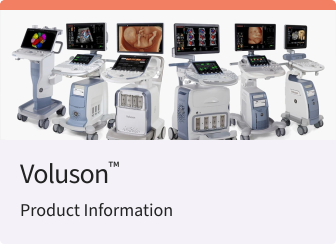
Just as AI has simplified many aspects of our everyday lives, it now plays an important supportive role in women’s health ultrasound. GE HealthCare’s AI-enhanced Voluson systems help clinicians streamline daily workflows, save time during key procedures, and boost diagnostic confidence.
Many innovative AI features are already in active clinical use, allowing healthcare providers to focus more on what truly matters: meeting their patients’ needs.
- SonoLyst™: AI-powered tools to identify fetal anatomy, auto-annotate/measure, and reduce ISUOG second-trimester exam time (up to 40%).
- SonoCNS™: Streamlines fetal brain analysis via 3D volume alignment for consistent views and measurements.
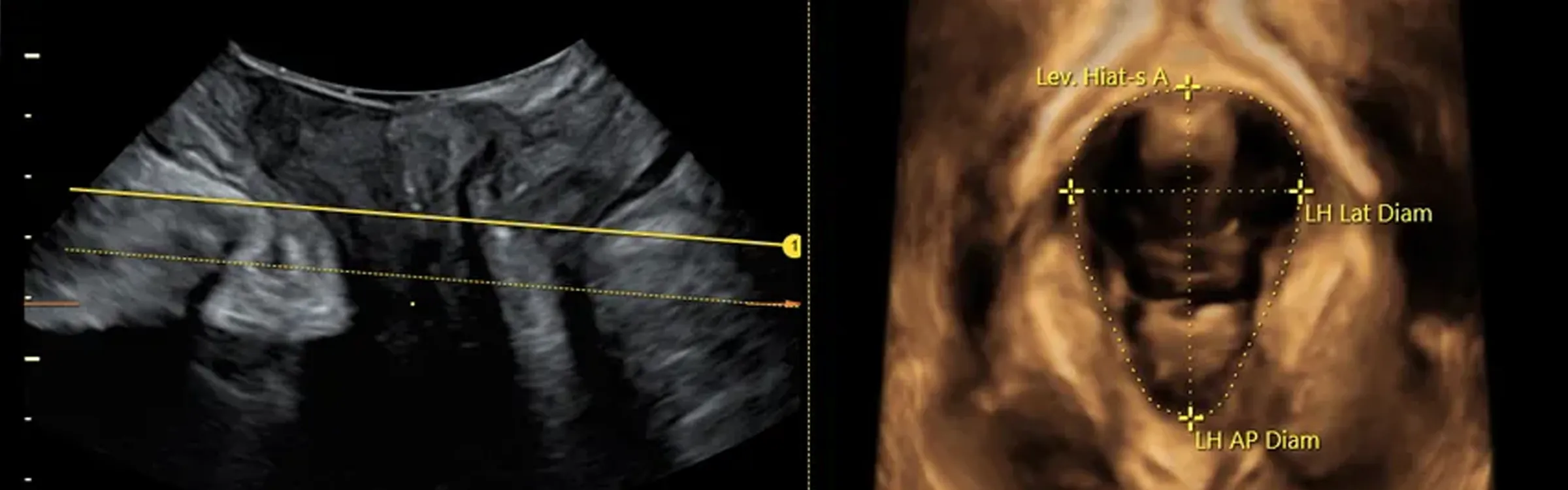
- SonoPelvicFloor: Automates pelvic floor assessments, reducing keystrokes (up to 76%).
- Fibroid Mapping: AI-driven documentation for mapping, measuring, and classifying fibroids.
- fetalHS: Accelerates fetal heart assessments with AI-guided anatomy analysis and reducing exam time (up to 48%).
Interested in learning more?
Explore how AI-enhanced Voluson systems can transform your workflow and enhance patient care.
References:
1. Chen Z, Liu Z, Du M, Wang Z. Artificial Intelligence in Obstetric Ultrasound: An Update and Future Applications. 2021.
2. Drukker L, Noble J, Papageorghiou AT. Introduction to artificial intelligence in ultrasound imaging in obstetrics and gynecology. 2020.
3. Iftikhar P, Kuijpers M, Khayyat A, Iftikhar A, DeGouvia De Sa M. Artificial Intelligence: A New Paradigm in Obstetrics and Gynecology Research and Clinical Practice. 2020.
4. Jost E, Kosian P, Jiménez Cruz J, et al. Evolving the Era of 5D Ultrasound? A Systematic Literature Review on the Applications for Artificial Intelligence Ultrasound Imaging in Obstetrics and Gynecology. 2023.
5. Malani SN, Shrivastava D, Raka M. A Comprehensive Review of the Role of Artificial Intelligence in Obstetrics and Gynecology. 2023.
6. Safiullina ER, Rychkova EI, Мayorova IV, et al. Application of digital methods and artificial intelligence capabilities for diagnostics in obstetrics and gynecology. 2023.
7. Ito Y, Miyoshi A, Ueda Y, et al. An artificial intelligence-assisted diagnostic system improves the accuracy of image diagnosis of uterine cervical lesions. 2021.
8. Lei T, Zheng Q, Feng J, et al. Enhancing trainee performance in obstetric ultrasound through an artificial intelligence system: randomized controlled trial. 2024.
9. Dhombres F, Bonnard J, Bailly K, Maurice P, Papageorghiou AT, Jouannic JM. Contributions of Artificial Intelligence Reported in Obstetrics and Gynecology Journals: Systematic Review. J Med Internet Res. 2022 Apr 20;24(4):e35465.
JB01654AFG
Other Topics

Ultrasound in Labor & Delivery: From Objective Assessment to Future Innovation

The Role of Ultrasound in the Early Diagnosis and Follow-Up of Preeclampsia
The Pelvic Floor: More than “Just a Muscle”

Ultrasound in ART: A pivotal tool for infertility diagnosis and treatment success

The Role of Advanced Ultrasound Features in Infertility

The Emerging Impact of Handheld Ultrasound Across Obstetrics

Understanding Endometriosis – What, Why and How
Fetal Heart