 Clinical specialty
Infertility is a deeply challenging journey for many, often requiring a multi-faceted treatment approach. Ultrasound technology stands as one of the most crucial tools in managing and treating infertility, especially in guiding medical interventions. For those seeking fertility solutions, treatment often involves three critical steps: evaluation to diagnose underlying causes, monitoring to track follicle growth and reproductive health, and procedural guidance during treatments like oocyte retrieval and embryo transfer. Ultrasounds play a key role throughout this process, offering essential support and reassurance in diagnosing, monitoring, and guiding care with precision and compassion.
The critical role of ultrasounds in infertility diagnosis and treatment
As a minimally invasive and highly effective diagnostic tool, ultrasounds are utilized throughout Assisted Reproductive Technologies (ART) to help doctors assess and manage infertility at various stages. From the initial pre-treatment assessments to monitoring cycles, guiding procedures, and assessing the outcomes of interventions, ultrasounds play a pivotal role in reproductive medicine.
Ultrasounds are especially important for diagnosing the causes of infertility, such as conditions like polycystic ovarian syndrome (PCOS), uterine fibroids, or structural abnormalities in the reproductive organs. They also help in monitoring follicle development and serve as guiding tools for key procedures like oocyte (egg) retrieval and embryo transfers.
Pre-treatment evaluation: early steps in the infertility journey
The journey of ART begins with the evaluation of the patient’s reproductive organs, a process in which ultrasound machines play a vital role. High-resolution ultrasound images allow doctors to assess the pelvic organs, including the uterus, ovaries, and fallopian tubes. This stage is essential for detecting abnormalities such as fibroids, cysts, or other structural issues that could be causing infertility.
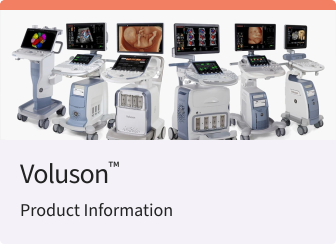
For patients with fibroids, which are common in the infertile population, fibroid mapping technology helps gauge whether the fibroids should be treated before proceeding with ART. Professor Michaël Grynberg, a renowned expert in reproductive medicine and fertility preservation, emphasizes that “the biggest challenge in female fertility workup is to have an optimal, accurate fertility workup without being too invasive for the patient and without too many tests”. This step thus ensures that only necessary treatments are pursued, optimizing the patient’s chances of success while minimizing unnecessary interventions. In this regard, advanced ultrasound technologies like Voluson™ SWIFT provide clinicians with rapid, high-quality images, enabling accurate diagnoses with minimal discomfort to the patient.
Monitoring the treatment process: tracking follicle growth
Follicle tracking is a crucial aspect of fertility treatment. Ultrasound scans are used to monitor the growth of follicles, which contain the eggs that will be retrieved for procedures like In Vitro Fertilization (IVF). Effective and precise follicle tracking is essential for timing oocyte retrieval and ensuring that the patient is responding well to fertility medications.
Automation tools like SonoAVC™antral2.0 and SonoAVC™follicle are designed to improve both the efficiency and consistency of follicle tracking. These are invaluable in a busy clinical setting, where managing multiple patients can be time-consuming and challenging. Nadia Benmoussa, application specialist at GE HealthCare Austria, highlights how this technology has improved efficiency, stating that it is "less time-consuming and improves the patient experience." The automation provided by these tools helps streamline the workflow, allowing clinicians to focus on providing personalized care.
Procedural guidance: enhancing success with ultrasound technology
One of the most delicate and critical procedures in ART is oocyte retrieval, where ultrasound guidance is indispensable. Accurate needle visualization during oocyte retrieval helps ensure the safety and success of the procedure. GE HealthCare has partnered with Vitrolife to enhance this process by optimizing ultrasound systems for needle visibility during retrievals. This partnership provides a clear and precise guide for the doctor, improving outcomes while minimizing patient discomfort.
In addition to needle visualization, 3D ultrasound and sonohysterograms offer advanced imaging that can provide a more comprehensive understanding of the patient's reproductive health. These technologies allow clinicians to visualize the structure of the uterus and other reproductive organs in three dimensions, providing a detailed map that can guide treatments with greater precision.
Ultrasounds as a cornerstone in infertility treatment
Infertility affects millions of people worldwide, bringing with it significant emotional and financial burdens. For couples struggling to conceive, ultrasound technology has become a cornerstone in the diagnosis and treatment of infertility, offering a minimally invasive and highly effective solution throughout the journey of ART. Whether used in the initial evaluation of reproductive health, the monitoring of follicle development, or the precise guidance of complex procedures like oocyte retrieval, ultrasound enables clinicians to provide better outcomes with greater accuracy and patient comfort.
As one of the leaders in reproductive medicine imaging, GE HealthCare’s Voluson ultrasound systems continue to push the boundaries of what is possible in this field. By offering innovative, user-friendly tools that enhance both the patient experience and the clinician's workflow, ultrasound technology is playing an essential role in helping couples achieve their dream of parenthood. The path to a successful pregnancy is paved with innovations that not only improve clinical outcomes, but also offer hope and support to those navigating the difficult journey of infertility.
JB01492AFG
Other Topics

Ultrasound in Labor & Delivery: From Objective Assessment to Future Innovation

The Role of Ultrasound in the Early Diagnosis and Follow-Up of Preeclampsia

AI in OB/GYN Ultrasound
The Pelvic Floor: More than “Just a Muscle”

The Role of Advanced Ultrasound Features in Infertility

The Emerging Impact of Handheld Ultrasound Across Obstetrics

Understanding Endometriosis – What, Why and How
Fetal Heart